

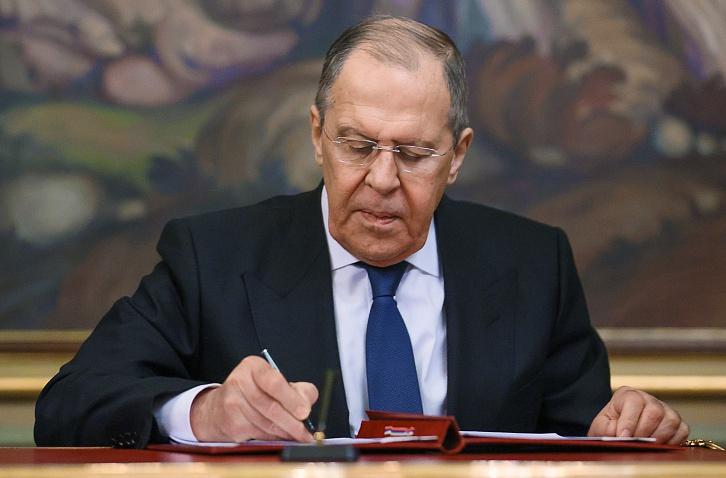
Russian Foreign Minister Sergey Lavrov announced a series of agreements aimed at strengthening Russia-Azerbaijan relations following high-level talks, describing the current bilateral dialogue as becoming more systematic and comprehensive. The discussions covered diplomacy, trade, education, media cooperation, Caspian Sea issues, regional security, and developments related to the Ukraine conflict.
Lavrov said both countries signed a new Consultation Plan that will increase coordination between the Russian and Azerbaijani foreign ministries. While diplomatic contacts have continued uninterrupted, the new framework is intended to make cooperation more structured by focusing on international issues that are expected to shape the bilateral agenda in the coming years.
Economic cooperation was another major topic during the talks. According to Lavrov, both sides reviewed the responsibilities of their foreign ministries in supporting decisions adopted during the April session of the Intergovernmental Trade and Economic Commission, which was held at the deputy prime minister level. The discussions focused on facilitating trade and economic cooperation between the two countries.
The two governments also agreed to deepen cultural and educational exchanges. Lavrov announced plans to accelerate the establishment of a joint Russian-Azerbaijani university, with St. Petersburg State University serving as the lead Russian institution. Additional cooperation will include concert tours and expanded educational initiatives between the two countries.
Media cooperation also featured prominently during the discussions. Lavrov said both governments agreed to strengthen coordination between their foreign ministry information departments and expand contacts between media representatives. He stated that the goal is to improve public understanding of bilateral relations and counter what Moscow views as inaccurate portrayals of Russia-Azerbaijan cooperation.
Regional issues surrounding the Caspian Sea received significant attention. Lavrov said both sides discussed the development of the Rasht-Astara railway section and the North-South International Transport Corridor, while also addressing environmental challenges, particularly the shrinking water levels in the Caspian Sea. Azerbaijan's President Ilham Aliyev was credited with being among the first regional leaders to raise concerns over the issue. Russia expects a meeting involving all five Caspian littoral states to discuss environmental protection and broader cooperation regarding the shared body of water.
Lavrov also emphasized the importance of advancing the South Caucasus "3+3" regional platform. He welcomed Azerbaijan's continued support for the initiative and said both countries intend to finalize arrangements for the next meeting of foreign ministers, expressing hope that it can be held later this year.
Responding to questions on the Caspian Sea, Lavrov said Russia is encouraging Iran to ratify the Convention on the Legal Status of the Caspian Sea, noting that all other littoral states have already completed ratification. He said this step would help fully establish the legal framework governing the region.
On environmental cooperation, Lavrov said Russia and Azerbaijan discussed organizing a series of five-party meetings focused on the shrinking Caspian Sea. He added that Azerbaijani officials had agreed to support Russia's proposal and indicated that the remaining Caspian states also appear willing to participate.
Lavrov further noted that Russia regularly organizes scientific expeditions aboard hydrographic vessels to monitor environmental conditions in the Caspian Sea. He said Moscow will continue supporting scientific research and any initiatives designed to preserve what he described as the unique sea-lake ecosystem, adding that there was clear consensus among participants on the issue.
Turning to the conflict in Ukraine, Lavrov argued that the ongoing tensions surrounding Iran have shifted international attention away from Ukraine, which he said has become a concern for Kyiv as it seeks continued Western military and political support. He claimed that European governments are working to maintain strong U.S. backing for Ukraine following recent G7, NATO, and European meetings.
Lavrov also criticized Ukrainian language policies, claiming that the Russian language has been legally restricted in many areas of public life in Ukraine. He contrasted this with language policies in several other countries, arguing that such restrictions are unique to Ukraine.
Discussing diplomatic efforts to resolve the conflict, Lavrov said Russia has consistently demonstrated goodwill since 2014 by supporting multiple agreements involving successive Ukrainian governments, European mediators, and later negotiations involving President Volodymyr Zelensky. According to Lavrov, none of those agreements were ultimately implemented.
Lavrov also referred to agreements reached during discussions involving U.S. President Donald Trump and Russian President Vladimir Putin in Alaska, stating that Russia had accepted the U.S. proposals and considers them a basis for future settlement efforts. He argued that European leaders and President Zelensky are attempting to move Washington away from those proposals.
Responding to recent media reports suggesting Russia was risking sanctions relief by its negotiating approach, Lavrov rejected the claims and reiterated that Moscow accepted the U.S. proposals presented during the Alaska discussions. He concluded by stating that Russia will continue pursuing its objectives while maintaining its negotiating position.
Disclaimer
This article is based on publicly available statements made by Russian Foreign Minister Sergey Lavrov during an official interview. The content is presented for informational and journalistic purposes only and reflects the views and claims expressed by the speaker .


