

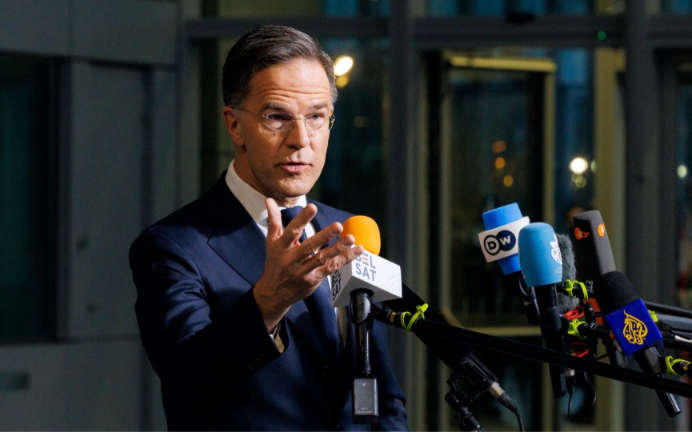
The NATO Secretary General delivered a strong message to political leaders, military officials, and defense industry executives during the NATO Summit Defense Industry Forum 2026, emphasizing that the alliance must rapidly expand defense production and strengthen cooperation to address growing global security challenges.
Opening his address with a football analogy, the Secretary General said that no successful team wins because of a single star player. Instead, success comes from the combined efforts of everyone involved—from players on the field to coaches, analysts, and support staff. He compared this to NATO, where governments, armed forces, and defense industries all play equally important roles in maintaining collective security.
He stressed that NATO provides defense requirements while industry must transform those needs into real military capabilities. According to him, the partnership between governments and defense manufacturers has grown significantly since he assumed office in 2024, citing visits to defense factories and meetings with engineers, executives, and production workers across allied countries.
Highlighting the alliance's recent achievements, the Secretary General noted that NATO members committed to investing 5% of GDP in defense during the previous summit. He stated that European allies and Canada increased defense spending by nearly 20% over the past year, representing an additional $139 billion. Combined spending increases during 2025 and 2026 totaled approximately $258 billion, demonstrating what he described as a long-term commitment rather than a temporary surge.
The Secretary General emphasized that these investments must translate into real military capabilities. He revealed that approximately $37 billion has been invested directly into expanding the defense industrial base over the past year, resulting in larger factories, new production lines, and increased manufacturing capacity. According to him, the newly created production space is equivalent to more than 2,000 football pitches.
During the forum, multiple defense contracts worth tens of billions of dollars were announced. These agreements include investments in air defense systems, long-range strike capabilities, satellite communications, ammunition production, drones, counter-drone technologies, and improvements in military resilience and preparedness.
One of the major announcements concerned ammunition production. The Secretary General projected that by next year, NATO countries will have the capacity to manufacture approximately four million artillery shells annually, nearly double the alliance's previous production capacity.
Despite this progress, he warned that NATO cannot afford to slow down. He argued that the current international security environment requires faster production and greater cooperation between governments and industry.
The Secretary General pointed to Russia's military spending as one of the primary reasons for accelerating defense production. He claimed that Russia is allocating nearly half of its national budget to military purposes and that not only its defense sector but also much of its broader industrial base is supporting the country's war effort.
He also expressed concern over China's continued military modernization and expansion of its nuclear capabilities, saying these developments lack sufficient transparency. North Korea was also mentioned for expanding its nuclear program and supplying military support to Russia.
Regarding Iran, the Secretary General stated that recent U.S. military actions had significantly degraded Iran's nuclear and ballistic missile programs, while adding that NATO must remain vigilant toward future developments.
He argued that these security challenges require what he described as a "transatlantic defense industrial revolution." Calling for faster procurement processes, he urged governments to reduce bureaucracy, simplify cross-border regulations, place long-term defense contracts, and continue investing in production capacity.
The Secretary General also encouraged defense companies to take greater commercial risks, assuring industry leaders that defense demand would continue to grow as NATO members increase military spending. For the first time, NATO has publicly released a consolidated demand signal outlining future military capability requirements to help companies plan long-term investments.
He emphasized that expanding defense production will require reliable energy supplies, secure supply chains, and a larger skilled workforce, including engineers, technicians, and innovators.
International cooperation formed another major theme of the speech. The Secretary General highlighted NATO's collaboration with Ukraine, praising the country's rapid innovation in drone technologies and confirming plans to expand industrial cooperation and joint defense production.
He also welcomed increased cooperation with the European Union and Indo-Pacific partners, including Japan, stating that combining technological expertise and industrial capabilities across allied nations would strengthen collective security.
Concluding his address, the Secretary General returned to his football comparison, saying successful teams prepare, train, invest, and continuously improve. He described the partnership between NATO governments and the defense industry as essential to ensuring the alliance remains capable of protecting its members in an increasingly uncertain global security environment.


