

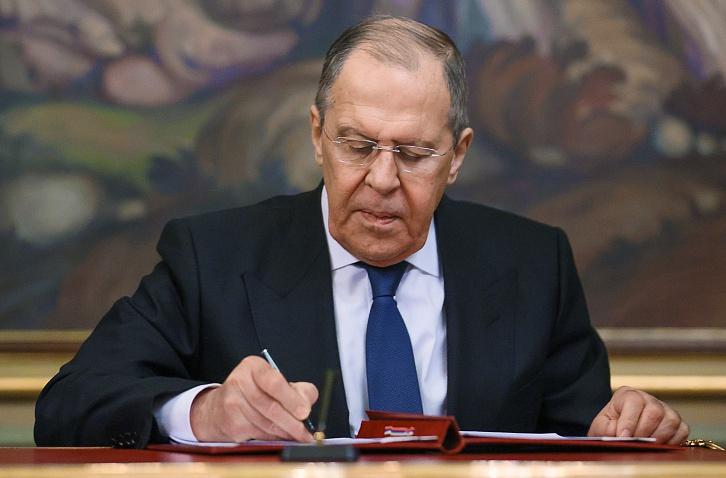
Russian Foreign Minister Sergey Lavrov said cooperation among major Eurasian regional organizations is gradually expanding, while also addressing the prospects for negotiations involving Russia, Ukraine and the United States.
Speaking during a media interaction, Lavrov highlighted what he described as the emerging idea of a “Greater Eurasian Partnership,” saying that different regional organizations should establish closer relationships, coordinate their programs and projects, and develop a more rational division of responsibilities.
Russia Pushes Greater Coordination Across Eurasian Organizations
Lavrov said agreements have already been established between the secretariats of the Commonwealth of Independent States (CIS), the Eurasian Economic Union (EAEU), and the Shanghai Cooperation Organisation (SCO).
According to Lavrov, these arrangements represent an initial step toward harmonizing the programs of different Eurasian institutions.
He said other regional structures are also becoming involved in the process and emphasized that all subregional organizations across the Eurasian continent are welcome to participate.
Lavrov added that countries that are not currently members of any regional organization could also join the broader cooperation process.
“Work is not easy,” Lavrov said, pointing to the size of the Eurasian continent, its history and the diversity of civilizations across the region. He argued that diplomacy and foreign policy should help bring different initiatives toward a common direction.
Regular Contacts Between Regional Organizations
Lavrov said cooperation between the organizations has already moved beyond political statements.
He pointed to memorandums of cooperation between several secretariats, regular contacts among their officials and reciprocal visits by the heads of the organizations.
According to the Russian foreign minister, these meetings involve not only comparisons of assessments of the international situation but also discussions about possible joint actions.
Lavrov said such coordination takes into account the medium- and long-term programs of each organization.
He acknowledged that deeper integration would be a complicated and lengthy process but expressed confidence that Eurasian security and a broader Eurasian economic space would gradually develop.
Lavrov Addresses Possible Russia-Ukraine-U.S. Talks
During the same interaction, Lavrov was asked about Ukrainian President Volodymyr Zelenskyy's recent statement that the United States had proposed trilateral negotiations involving Russia, Ukraine and the United States.
Lavrov said Moscow had previously acknowledged receiving an American proposal for negotiations.
According to Lavrov, Russia agreed in principle while indicating that certain domestic political processes needed to take place first, after which the timing and agenda of negotiations could be discussed.
Lavrov claimed that Russia subsequently raised concerns about security incidents during Russia's parliamentary elections and said Moscow wanted to understand what proposals Ukraine would bring to potential negotiations.
He said the United States had taken Russia's arguments into consideration.
Lavrov Cites Previous Negotiation Attempts
Lavrov argued that Russia has repeatedly participated in efforts aimed at reaching concrete agreements over the Ukraine conflict.
He referred to several previous diplomatic initiatives, including the Minsk agreements, the 2019 Paris agreements and negotiations held in Istanbul in 2022.
According to Lavrov, the Istanbul process included proposals for a potential settlement and said Russia and Ukrainian representatives had initialled a draft framework.
Lavrov also claimed that subsequent political developments prevented the process from moving forward. He specifically criticized former British Prime Minister Boris Johnson, alleging that Johnson discouraged Ukraine from proceeding with the proposed settlement.
These claims have been disputed by Ukraine and Western governments, which have offered different accounts of the reasons negotiations broke down.
Russia Says It Remains Open to Negotiations
Lavrov also referred to later negotiations involving Russia, Ukraine and the United States, including meetings in Abu Dhabi, saying that Moscow had participated in these efforts.
He maintained that Russia had repeatedly accepted proposals for diplomatic engagement and argued that Moscow should not be blamed for the failure of previous negotiation processes.
Lavrov also criticized European governments, accusing them of exerting pressure that undermined previous U.S.-Russia diplomatic initiatives.
The Russian foreign minister concluded by expressing hope that questions about the breakdown of previous negotiations would also be directed toward Ukraine, the United States and European governments.
Broader Eurasian Integration Remains a Russian Priority
Lavrov's remarks underline Moscow's continued emphasis on building stronger economic, political and security links across Eurasia.
Russia is seeking greater coordination among organizations such as the CIS, EAEU and SCO, while encouraging other regional structures and countries to participate.
At the same time, the comments show that the Ukraine conflict and the prospects for future negotiations remain closely connected to Russia's broader foreign-policy agenda.
The extent to which these Eurasian organizations can coordinate their long-term programs, and whether renewed diplomatic efforts can produce concrete agreements on Ukraine, will depend on the positions of Russia, Ukraine, the United States and other major international actors.
Disclaimer
This article is based on statements attributed to Russian Foreign Minister Sergey Lavrov and reflects the Russian side’s account of diplomatic events. Claims regarding previous negotiations, Ukraine, the United States and European involvement are disputed by the parties concerned. Readers should consult official statements from all relevant governments for a complete picture.


