



Global financial markets are witnessing a sharp rise in long-term government bond yields across the world’s largest economies, triggering growing fears that the global economy could be heading toward another major recessionary phase. Investors are increasingly worried that simultaneous stress in the bond markets of the United States, United Kingdom, and Japan may signal deeper structural problems in the global financial system.
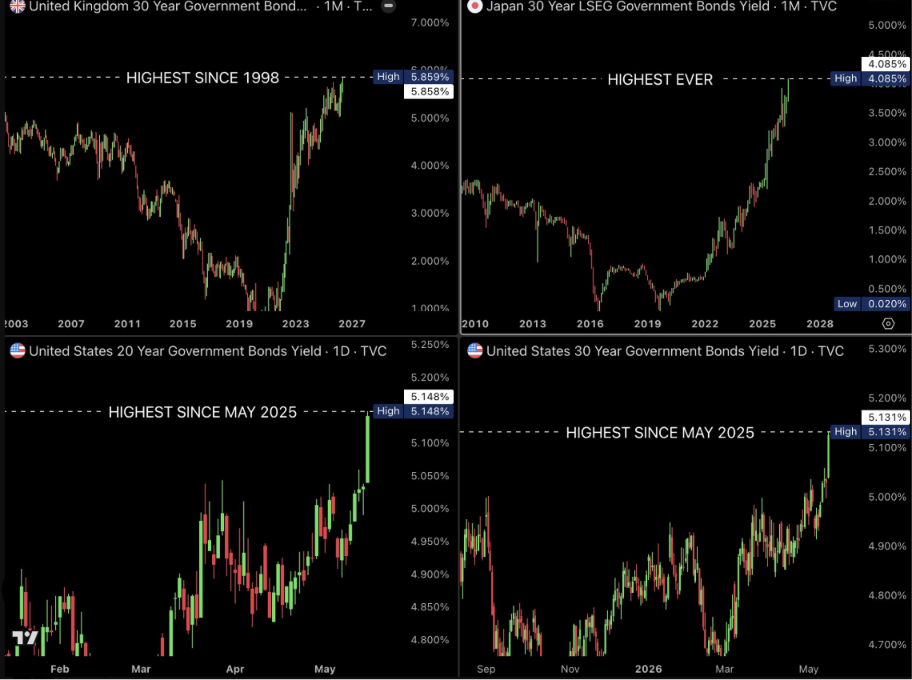
The latest market data shows a dramatic rise in sovereign bond yields:
- UK 30-year gilt yields climbed to 5.859%, their highest level since 1998.
- Japan’s 30-year government bond yield surged to 4.085%, the highest level ever recorded.
- US 20-year Treasury yields rose to 5.148%.
- US 30-year Treasury yields touched 5.131%, both reaching their highest levels since May 2025.
The synchronized rise in yields is creating concern among economists and market participants because government bonds are generally considered the foundation of the global financial system. When borrowing costs rise sharply across multiple developed economies at the same time, it often reflects inflation fears, policy uncertainty, and weakening investor confidence.
Japan’s Bond Market Could Trigger a Global Ripple Effect
Japan has emerged as one of the key focal points in the current bond market turmoil. Inflation in Japan has now remained above the Bank of Japan’s 2% target for four consecutive years, putting mounting pressure on policymakers to tighten monetary policy further.
At the same time, the Japanese yen continues to weaken despite repeated intervention attempts by Japanese authorities. Every time the Bank of Japan intervenes in currency markets, the USD/JPY pair reportedly rebounds higher, suggesting that markets remain unconvinced about the effectiveness of current policy measures.
As inflation pressures persist, markets increasingly believe the Bank of Japan may have only one option remaining: raise interest rates.
If the BOJ moves toward additional rate hikes, Japanese bond yields could rise even further. This would narrow the yield differential between US Treasuries and Japanese government bonds, potentially triggering a massive reversal in global capital flows.
For years, global investors have borrowed cheap yen and invested those funds into higher-yielding US assets through what is commonly known as the yen carry trade. If Japanese yields become more attractive, investors could begin unwinding these positions and redirecting money back into Japan.
Such a move would likely push US Treasury yields even higher as investors reduce exposure to American bonds. Rising yields could then trigger additional selling pressure, creating a self-reinforcing cycle in global debt markets.
Investors still remember the market shock seen during a similar unwind in 2024, when Japan’s Nikkei index plunged 12.4% in a single trading session, marking its worst daily performance since 1987. Analysts now warn that the current setup appears even larger and potentially more dangerous.
UK Bond Market Faces Pressure From Oil Prices and Political Instability
The United Kingdom is also experiencing severe stress in its government bond market. Analysts point to surging energy prices as one of the primary drivers behind the recent rise in gilt yields.
The ongoing US-Iran conflict has reportedly pushed oil and gas prices above levels seen during the peak of the 2022 Russia-Ukraine energy crisis. Higher energy prices are intensifying inflation concerns across Europe and increasing expectations that central banks may need to maintain tighter monetary policies for longer.
In the UK specifically, market expectations have shifted dramatically. Investors previously anticipated around 50 basis points of interest rate cuts from the Bank of England. However, expectations have now swung toward approximately 60 basis points of rate hikes by the end of 2026.
This represents a massive 115 basis point shift in policy expectations within just a few weeks.
Political instability is adding another layer of pressure on British markets. Concerns surrounding Prime Minister Keir Starmer’s leadership and broader political uncertainty have reportedly increased investor anxiety. Any sign of instability in government leadership tends to push gilt yields higher as investors demand greater compensation for holding UK debt.
The UK enters this period of uncertainty with public debt approaching 100% of GDP. At the same time, gilt issuance is expected to exceed £250 billion during the current fiscal year, increasing concerns about the country’s long-term debt sustainability.
US Treasury Yields Near Historically Sensitive Levels
In the United States, Treasury yields are also climbing rapidly. Market observers note that if US bond yields rise only slightly further, they could approach levels last seen during the period surrounding the 2007 global financial crisis.
Higher Treasury yields increase borrowing costs across the economy, affecting mortgages, corporate debt, consumer loans, and government financing expenses. Elevated yields can also place significant pressure on equity markets as investors move capital toward safer fixed-income assets offering higher returns.
The combination of persistent inflation, geopolitical tensions, elevated oil prices, and rising fiscal deficits has created an environment where investors are demanding higher yields to compensate for growing risks.
Fears of a Global Recession Grow
Historically, simultaneous breakdowns across major bond markets have often served as early warning signals for broader economic downturns. The current environment is especially concerning because stress is appearing across nearly all major developed economies at the same time.
The bond market is widely viewed as one of the smartest indicators of future economic conditions. Sharp rises in long-term yields typically reflect expectations of stubborn inflation, tighter monetary policy, slower economic growth, or fiscal instability.
With Japan facing inflation pressures, the UK dealing with energy shocks and political concerns, and the US seeing Treasury yields approach recession-era levels, investors are increasingly questioning whether the global economy may be entering another period of financial instability.
As volatility continues to rise across debt markets, global investors will closely monitor central bank decisions, inflation data, energy prices, and geopolitical developments in the coming months.
Disclaimer:
This article is for informational and educational purposes only and should not be considered financial, investment, or trading advice. Readers should conduct their own research and consult with a qualified financial advisor before making any investment decisions. Market conditions can change rapidly, and opinions mentioned in this article are subject to change without notice.


